ERPNext vs Tally
Tally is accounting software, and ERPNext is a full ERP with accounting built in. Once you know which of those your business actually needs, the rest of the decision gets much easier.
By Asif Mulani, who built Frappe Sheets · Published
The short answer
Which one fits your business.
- Tally
Pick TallyPrime if
You need books, GST and maybe payroll for a small team, and your accountant already works in it. It's cheap, quick to get going, and it does that job well.

Pick ERPNext if
Your stock, production, sales orders or other locations are tracked outside the books today, and someone reconciles them into Tally every month. ERPNext keeps all of that in one system, so the monthly reconciliation goes away.
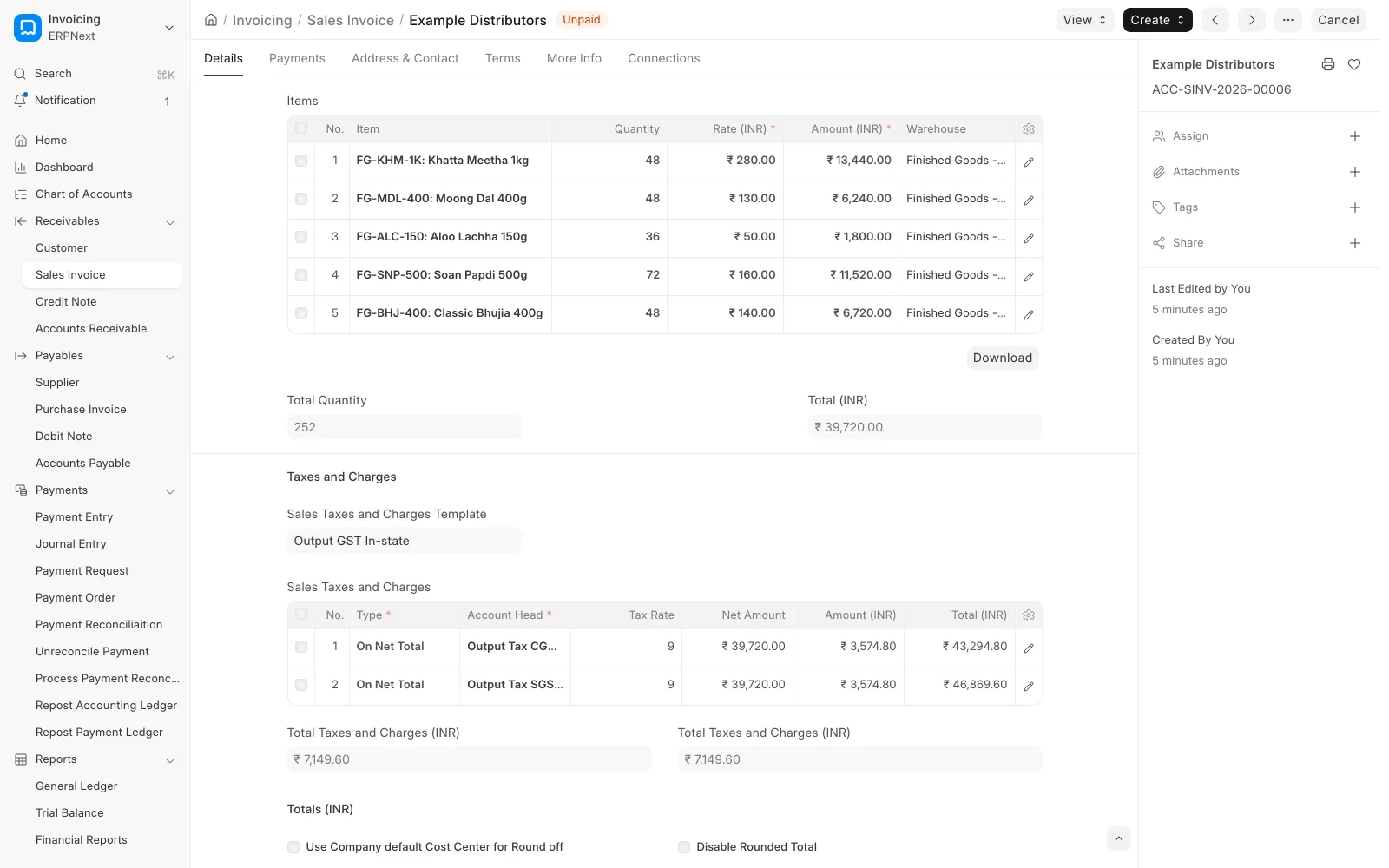
Side by side
Prices and features as published by each vendor, checked on 20 October 2026. Sources are listed at the end.
| Aspect | ERPNext | TallyPrime |
|---|---|---|
| Licence | Open source, GPL v3. The Frappe Framework under it is MIT. No licence fee per user or per module. | Proprietary. Sold per edition: Silver for a single PC, Gold for multiple users on multiple PCs. |
| Pricing | No licence cost. You pay for hosting and for implementation. | Silver ₹22,500 lifetime or ₹750 a month. Gold ₹67,500 lifetime (includes TSS) or ₹2,250 a month. 18% GST extra on all. |
| Hosting | Self-host on any Linux server, or Frappe Cloud from ₹410 a month for a shared site and ₹3,600 a month for a server. Not priced per user. | Installed on your PCs. TallyPrime Cloud Access, on Oracle Cloud, is a paid add-on. |
| Modules | Accounts, stock, buying, selling, manufacturing, subcontracting, projects, assets, quality, support. CRM and HR run as separate Frappe apps on the same framework. | Accounting, inventory, GST and other statutory compliance, and payroll. |
| Customisation | Custom fields, forms, reports and workflows from the desk. Bigger changes go into a separate Frappe app of your own, so nobody edits the ERPNext core. | Through TDL, Tally's own development language, usually by a Tally partner. |
| GST, e-invoice, e-way bill | Through the India Compliance app (GPL v3): e-invoice and e-way bill with the NIC portal, GSTR-1 preparation, purchase reconciliation against GSTR-2A and 2B. The GST API features need a paid India Compliance account. | Built in. e-invoicing and e-way bills are listed in the edition features. |
| Payroll | Frappe HR, a separate GPL v3 app. PF, ESI and professional tax are set up as salary components, and we check them against figures worked out by hand before the first real payroll month. | Built in: pay heads for PF, ESI, NPS, professional tax and income tax, with Form 16 and Form 24Q. |
| Data ownership and export | Your own database. Any list exports to Excel or CSV, and every record is reachable over a REST API. | Company data sits on your machine. Exports to Excel and XML, and ODBC access for reporting. |
| Implementation effort | Four to eight weeks for a focused CRM or HR build. Three to six months for a full ERP with migration. | Small. Most Indian accountants already know Tally, and that's its biggest advantage. |
When TallyPrime is the better choice
- Your need is accounting and statutory compliance, and stock is simple or absent.
- Only one or a few people use it, on PCs in one office.
- Your chartered accountant works in Tally and you want to hand over data in the format they know.
- Your budget is tight. A Silver licence is ₹22,500 plus GST, paid once, and there's no implementation project to pay for.
When ERPNext is the better choice
- Your operations run in spreadsheets or another system, and someone reconciles them into Tally every month.
- You manufacture, subcontract, or hold stock across several warehouses with batches or serial numbers.
- People need access from more than one office, or from a browser on the road.
- You want CRM, HR and payroll on the same database as your ledger instead of in three separate products.
- You need workflows and approvals that fit your process rather than the other way round.
Moving from TallyPrime to ERPNext
How the move worksClean the masters, bring balances across as on a cutover date, and match the trial balance before go-live.
Most of the work in moving off Tally is reconciling, not copying data across. We map your chart of accounts to ERPNext's structure instead of dumping it in as is, and we deduplicate customer, supplier and item masters before import, because Tally files tend to collect three spellings of the same party.
Bring across opening balances as on a cutover date, and only as much transaction history as you'll actually look at. If you cut over at the start of a month or quarter, each GST return period stays in one system.
Don't go live until the trial balance matches in both systems. If you can spare the effort, run Tally and ERPNext side by side for one closing.
Next step
Sources
All checked on 20 October 2026. Vendor pages change, so confirm prices before you buy.
7 sourcesVendor pricing pages, help docs and licence files.
Questions buyers actually ask.
For most businesses, yes. ERPNext has the ledger, GST invoicing and, with the India Compliance app, e-invoicing, e-way bills and GSTR-1. Some businesses keep Tally for a year so their accountant can finish filings for the old period.
Not at first. A TallyPrime Silver licence is ₹22,500 plus GST, once. ERPNext has no licence fee but needs hosting and an implementation. It works out cheaper once it replaces the extra tools and the manual reconciliation that tend to build up around Tally.
Yes, through the India Compliance app, which connects to the NIC portal for e-invoices and e-way bills. The app is open source, but its GST API features need a paid India Compliance account.
Yes. They can be given a login with accounts permissions, and every report exports to Excel. They'll need a little time to adjust, since the screens and terms aren't the same as Tally's.
It depends on how much history you bring and how clean the masters are. A full ERP with migration usually runs three to six months, and the migration is one part of that.
Read next.
- Tally to ERPNext migrationYour books moved across with their history, in a form your auditor can check.
- ERPNext implementationAccounts, stock, purchase and sales on one ledger.
- What ERPNext costsHosting, implementation, and what pushes the price up or down.
- ERPNext vs Zoho BooksThe other common starting point for Indian small businesses.
Let's start with a call.
Thirty minutes, free of charge, and you won't sit through a sales deck.